Built-In Compensator vs Muzzle Device – What’s the Difference?
Last updated: March 2026
A built-in compensator is part of the barrel or slide assembly and cannot be removed. A muzzle device (external compensator) is a separate part threaded onto a barrel. Built-in comps like those on the SIG P365 FUSE Comp are optimized for the specific platform, while muzzle devices offer flexibility across multiple guns.
The Rise of the Integrated Compensator
Walk into White’s Arms today and you’ll see more compensated pistols on the shelf than at any point in the past decade. The technology has evolved from a specialty custom shop item to a factory option — and with that growth has come confusion about what these systems actually are and how they differ.
Let me clear this up in plain terms.
What Is a Built-In (Integrated) Compensator?
An integrated compensator is part of the firearm’s barrel or slide assembly. On the SIG P365 FUSE Comp, the compensator is built directly into the barrel unit — there’s no threading, no separate purchase, no installation required. When the factory ships the gun, the compensator is already there, already timed, already matched to the recoil spring weight and barrel length.
Other examples of integrated designs: Springfield Armory’s comp variants, Walther’s factory ported models, and some SIG Romeo/barrel combinations.
What Is a Muzzle Device (External Compensator)?
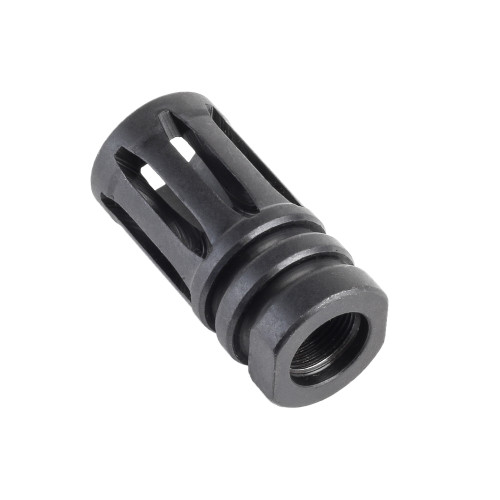
A muzzle device compensator is a threaded accessory that attaches to the end of a threaded barrel. You need a threaded barrel (which may be an aftermarket purchase), a timing tool or thread-locker to position it, and potentially a new holster. Examples include the Lone Wolf comp for Glocks and SureFire’s WARCOMP series.
External comps are more common on rifles than pistols, and require more setup. The KelTec KP50 has a threaded barrel and is designed to accept a suppressor or comp via the thread, making it a platform suited for external devices.
How Each Type Works
Built-In Compensator
The barrel has ports cut into the top. As a round is fired and the bullet passes the ports, expanding gas is vented upward. This upward force counteracts the muzzle’s natural tendency to rise under recoil — called “muzzle flip.” The result is a flatter-shooting gun with faster target reacquisition.
Muzzle Device
A muzzle device achieves the same effect — venting gas to counteract muzzle rise — but the ports are in a discrete device at the muzzle end of the barrel rather than built into the barrel body itself. The physics are the same; the implementation is different.
Comparison Table
| Feature | Built-In Compensator | Muzzle Device (External) |
|---|---|---|
| Requires threaded barrel? | No | Yes |
| Removable? | No (integral) | Yes |
| Holster compatibility | Requires comp-specific holster | Requires comp-specific holster |
| Setup complexity | None (factory complete) | Threading, timing, lock required |
| Platform-specific? | Yes — matched to gun’s specs | Can be swapped between threaded guns |
| Legal in all states? | Same as standard pistol | Some states restrict muzzle devices |
| Effect on cleaning | Clean ports during regular maintenance | Remove for cleaning (usually) |
| Effect on velocity | Slight reduction (gas vented before exit) | Same slight reduction |
| Examples | SIG P365 FUSE Comp, Hellcat Pro comp | Lone Wolf G-Comp, SureFire WARCOMP |
Does It Actually Reduce Recoil?
Technically, neither type of compensator reduces recoil — they reduce muzzle rise, which is the rotational motion of the muzzle upward after a shot. Actual felt recoil (the rearward push into your hand) is largely unaffected. The benefit is target reacquisition speed — the sights return to the target faster after each shot.
For rapid-fire shooting, faster follow-up shots, and practical accuracy at speed, both comp types provide measurable benefits. Tests comparing comp’d vs. uncomp’d P365 variants consistently show faster split times for most shooters.
Which Is Better for Carry?
For carry, the integrated comp wins on simplicity and reliability. The factory-integrated FUSE Comp doesn’t require timing tools, isn’t prone to working loose over time, and doesn’t require sourcing a compatible muzzle device. The muzzle device approach offers flexibility if you own multiple guns or want to remove the comp for specific applications.
Legal Considerations
Both types of compensators are legal in most U.S. states. Some states regulate “muzzle devices” broadly — California, for example, has restrictions. Check your local laws. In Utah and most Western states, both integrated and external comps are completely legal on pistols.
Related Products at White’s Arms
The SIG P365 FUSE Comp exemplifies the factory-integrated approach. For a full-size platform with a threaded barrel for muzzle devices, the S&W M&P9 M2.0 Metal and the KelTec KP50 both ship with threaded barrels. Browse our full handgun selection.
Frequently Asked Questions
Do I need a special cleaning routine with a compensator?
Yes. Compensator ports collect carbon fouling from gas venting. Clean the ports with a toothbrush and CLP during every cleaning session. For muzzle devices, remove and soak in CLP, then scrub. For integrated comps, use a bore brush and toothbrush at the port openings.
Are compensators louder?
Yes — both types redirect gas, which increases the muzzle blast perceived by bystanders and the shooter. Always wear hearing protection. At indoor ranges, a comp’d gun is noticeably louder than a standard barrel; be considerate of other shooters at close range.
Does a compensator affect reliability?
Factory-integrated comps are designed and tested with the gun’s specific recoil spring and ammunition range. Reliability is generally excellent. External muzzle devices require attention to timing — a loose muzzle device can affect reliability and accuracy. Factory-built systems avoid this problem entirely.
Can I add a muzzle device to the SIG P365 FUSE Comp?
The FUSE Comp’s integrated compensator barrel is not a threaded barrel for external devices. It’s a self-contained system. If you want a platform with a swappable muzzle device, you’d need a different base gun with a threaded barrel option.